Resilio Versio · the player’s guide
Manual
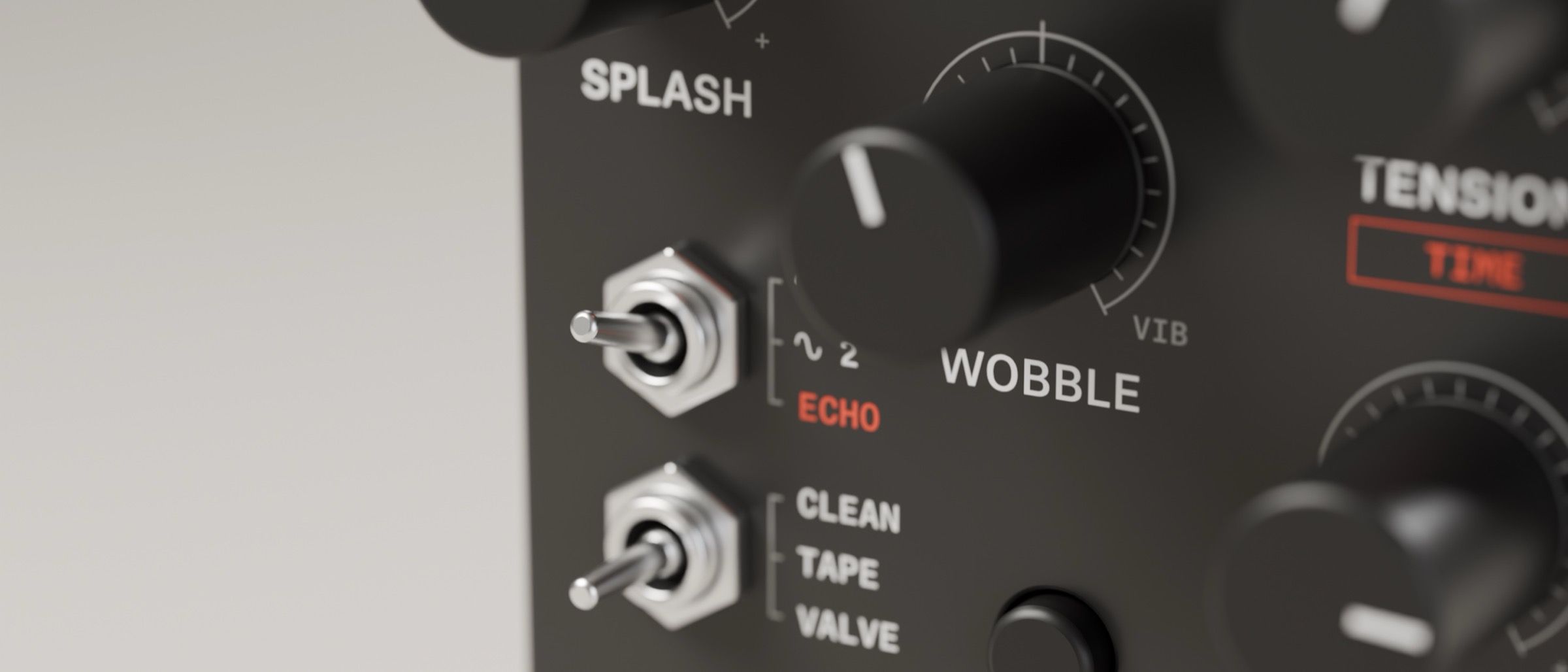
Resilio Versio is a dub spring reverb for the Noise Engineering Versio. It’s a simulated spring tank you can drive and splash, throw single hits into, or push until it feeds back, and the TANK switch’s third position puts a tape echo in front of it. The plugin has the same panel and the same sound.
Terminology
- Tank
- The whole reverb, with one or two springs inside.
- Tail
- The sound ringing on after you stop.
- Chirp
- The springy up-sweep (the "boing") on each echo.
- Throw
- Opening the springs to the input for a moment (one snare, one stab) and letting the tail ring on.
- Howl
- The tank feeding back on itself.
- Hold
- The tail left hanging as a bed under what you play.
Panel map
Resilio runs behind your Versio’s printed panel, so the printed labels don’t match. Use this map to find each control. Knobs are counted in reading order, top to bottom, left to right.
| Panel location | Resilio control |
|---|---|
| Top left knob | BLEND |
| Top right knob | DECAY |
| Centre knob, upper | TONE |
| Left knob, middle row | SPLASH |
| Right knob, middle row | TENSION |
| Centre knob, lower | WOBBLE |
| Right knob, lowest | DRIVE |
| Top switch | TANK: 1 · 2 · ECHO (up, centre, down) |
| Bottom switch | ATTITUDE: CLEAN · TAPE · VALVE (up, centre, down) |
| Button | THROW / TAP |
| Four LEDs, left to right | Input L, input R, output L, output R |
| Jacks, top two rows | CV for each knob, in the order drawn (BLEND, TONE, DECAY, DRIVE; SPLASH, WOBBLE, TENSION), and the THROW gate |
| Jacks, bottom row | In L, In R, Out L, Out R |
Controls
Clock positions are approximate. Fully left (7 o’clock) is the minimum, noon is the middle and fully right (5 o’clock) is the maximum.
BLEND
Dry ↔ wet. Fully right is 100 % wet, for a send/return, which is the classic dub way of throwing the snare into it. Fully left is your dry signal, untouched in every ATTITUDE.
DECAY
How long the tail rings, from a quick slap (about 0.4 s) to a long wash (about 9 s). It fades out everywhere except the very top (past about 4 o’clock), where what happens depends on ATTITUDE:
- CLEAN and TAPE: the hold. The tail stretches out toward minutes and sits as a bed under what you play, and it doesn’t get louder than what went in. New sound still joins it, a little quieter, and the whole bed dips out of the way of your kick and bass. Snares, hats and chords don’t make it dip.
- VALVE: the howl. The tank feeds back on itself into a rough, moving roar that keeps going after you stop. It doesn’t settle into a clean tone.
Pull DECAY back and either one falls into a normal tail and fades. In TANK ECHO, DECAY is the echo’s feedback instead (see Echo mode).
TONE
- Left: warm, dark dub. The drips and the boing are still there.
- Noon: neutral.
- Right: King Tubby’s “Big Knob”, a steep low cut on the reverb’s return, sweeping up to 800 Hz fully right. The further right you go, the more telephone-like and splashy it gets.
Because it sits after the springs, turning TONE right thins the tail that’s already ringing straight away, and turning it back brings the body back. Sharp hits like snares and rimshots also get a nasal “ring” just above the cut, like Tubby’s desk filter. Chords, pads and held sounds get the plain cut. The level stays about the same across the knob.
SPLASH
How hard your hits hit the springs. A loud, sudden hit rings the springs with its own highs, a bright clang. In TAPE and VALVE a drum hit also bites the input harder, which adds grit and a bigger tail. Chords get the clang but not the bite.
SPLASH doesn’t add a sound of its own. It’s your own hit, landing harder. It works the same at any DRIVE, so a quiet line-level send with DRIVE fully down still splashes. The last quarter (past about 3 o’clock) is much bigger, and you’ll hear it on any hit. Ghost notes in a groove stay quiet. Fully down there’s no splash at all, only a faint pitch wobble on hard hits in TAPE and VALVE.
TENSION
Which tank is fitted.
- Right = tight: a short tank with quick repeats and a small, bright chirp.
- Left = loose: a long tank with slow repeats and a big, dark boing.
Turning it while the tail rings bends the pitch, like tightening or slackening a string. In TANK ECHO, TENSION is the echo time instead (see Echo mode).
WOBBLE
Pitch movement, both ways from noon.
- Noon: still, though a tiny amount of movement stays on even here.
- Left: drift. Like tape, a smooth random wow with a faster flutter on top, and it doesn’t repeat. It’s gentle just left of noon, where held chords stay in tune, and wild fully left.
- Right: warble. A steady wobble whose speed drifts a touch, up to obvious worn-tape warble fully right.
CV adds to the knob, so from fully left a rising CV sweeps drift → still → warble. In TANK ECHO it moves the echo’s tape too.
DRIVE
The tank’s input, or how hard your signal hits it. It gives up to +24 dB of gain before anything else, so once DRIVE is up a quiet mixer send (peaks around −18 to −24 dBFS) drives the tank like a hot one.
Colour and grit build as you turn it up. It’s clean-ish to about 9 o’clock and driven from about 3 o’clock, and the colour steps up from CLEAN to TAPE to VALVE. The tail gets a few dB louder across the knob (about +6 dB from fully left to fully right) but doesn’t get shorter. SPLASH doesn’t depend on DRIVE. On hot material at full BLEND the output limiter starts catching peaks from about 1 o’clock.
TANK (top switch)
- 1 (left): one spring. Sparse and the most splashy.
- 2 (centre): two springs. The classic tank.
- ECHO (right): echo mode, a tape echo into the two-spring tank (below).
Switching crossfades, so it’s safe mid-tail. When you switch into ECHO the echo fades in on a fresh tape, and when you switch out of it, its last repeats ring on in the springs.
ATTITUDE (bottom switch)
Named for the saturation.
- CLEAN (left): a polite, linear tank. The reverb isn’t bit-reduced.
- TAPE (centre): tape saturation, the core dub colour. The reverb runs at 12-bit µ-law, which gives it a fine grain.
- VALVE (right): a spring in a cranked valve amp. The saturation inside the tank is hard and lopsided, with the growl of an overdriven valve stage, a rattle and lurch on hits, and the howl at the top of DECAY. The reverb runs at 10-bit µ-law, which is coarse and clearly gritty.
The grit comes from a 24 kHz µ-law converter that the reverb runs through in TAPE and VALVE, the companded grain of early digital delays and samplers. µ-law steps are coarse on loud sounds and fine on quiet ones, so hits get the most grit and a fading tail ends in grain, then silence. At 24 kHz the top octave (above about 11 kHz) is cut cleanly, with no aliasing. The converter sits before TONE, so TONE right of noon thins the grit along with the tail.
Flipping ATTITUDE changes the tail already ringing. The dry signal isn’t coloured or bit-reduced in any position, so BLEND fully left is a clean passthrough.
THROW / TAP button
In TANK 1 and 2 it throws. While you hold the button, the springs hear the input. Let go and they don’t, and what’s already ringing rings on.
- The first press switches throw mode on. Until then the reverb works as usual (the springs hear everything). From then on the springs only hear what you hold the button for.
- Each press is a throw, whether you tap it quickly or slowly or hold it for a bar.
- With the gate patched too, the springs hear the input while either one is on.
- To go back to always-on: tap, then press again straight away and keep holding for 2 seconds. All four LEDs blink white once, and the reverb works as usual until the next press or gate.
In TANK ECHO it taps the tempo. Each tap is a beat (a quarter note), and TENSION then picks the division, as it does with a clock at the gate. Three or four taps settle it, and it stays when you stop tapping. A single tap on its own, then nothing for about 2 seconds, lets it go (back to TENSION’s free time). If a clock is also patched into the gate, whichever you changed last wins. The LEDs flash purple on each tap, then pulse purple on the tapped beat for 4 seconds. In ECHO a press doesn’t throw.
Gate input
In TANK 1 and 2 it throws, so a sequencer can play the throws. While the gate is high (above about 2 V) the springs hear the input. While it’s low they don’t, and what’s already ringing rings on. The gate does nothing until it first goes high, so with nothing patched the reverb works as usual. To go back to always-on, use the button’s tap-then-hold (above). The next gate switches throw mode on again.
In TANK ECHO it’s the echo’s clock (one pulse per quarter note).
CV inputs
0–5 V, added to the knob’s position (turn the knob down to give CV room). BLEND, TONE, SPLASH and DRIVE follow CV quickly. DECAY, TENSION and WOBBLE glide, so they don’t zipper.
Audio in and out
- In L / In R: stereo in. For mono, patch In L only and it feeds both sides. Your dry signal stays stereo, and the springs hear left and right summed to mono, like a real tank. The inputs clip at about 16 V peak to peak.
- Out L / Out R: stereo out. A mono input still comes out wide.
Echo mode (TANK ECHO)
A worn tape echo in front of the two-spring tank. A quarter of each repeat goes through the springs and the rest comes straight off the tape, wide like two playback heads, so each repeat stays a distinct hit with a spring halo. The repeats wear like old tape. Loud, bright ones come back thicker and duller, and each pass is a little darker, with no digital fizz. The springs behind the echo are fixed at a medium tank.
Three controls change job in ECHO:
- DECAY = feedback, how many repeats. Fully down gives one repeat, about 10 dB down, and noon gives a few. Above that the builds get longer. At the very top the repeats hold, kept up by the tape’s saturation without running away. Bring DECAY down and they die away.
- TENSION = echo time. Running free, it’s 2 s fully left, about 0.4 s at noon and 80 ms fully right. With a clock (the gate, or tapped on the button) it picks a division of the beat instead, in seven zones from left to right: 1/2, dotted 1/4, 1/4, dotted 1/8, 1/8, dotted 1/16, 1/16.
- Gate = the clock, one pulse per quarter note (30–300 bpm). The tempo holds when the pulses stop, so stopping and starting your sequencer doesn’t move the echo. A single pulse on its own lets it go.
A change of echo time swoops like tape, with the repeats bending in pitch for a moment rather than jumping, so moving TENSION bends the repeats like a Space Echo’s rate knob. WOBBLE moves the tape, and TONE and ATTITUDE shape the repeats along with the springs. There’s no Hold in ECHO, and the top of DECAY holds the repeats rather than howling.
LEDs
- Left two: input level (In L, In R). Right two: output level (Out L, Out R).
- Green → amber → red as the level gets hot.
- Input red: you’re near clipping at the jack. Turn the source down.
- Output red: the safety limiter is catching peaks. That’s normal in a big howl. If it’s red all the time, lower DRIVE or DECAY.
- Held sounds (pads, drones, organ) rarely get there, because the tank notices a sound being held and gently turns down what goes into the springs to keep the wet clear of the limiter. Hits and stabs aren’t turned down, and the tail after you stop still rings its full length.
- White blink (all four, once): throw mode just went off.
- Purple (all four): tap tempo in TANK ECHO. A flash on each tap, then a pulse on each beat for 4 seconds, then back to the meters.
- At power-up a short colour sweep across the four LEDs says the firmware has loaded.
Quick start
- Patch a snare or rim hit into In L. Take Out L and Out R to your mixer.
- Set all the knobs to noon, TANK to the centre (2), ATTITUDE to the centre (TAPE).
- BLEND to about 2 o’clock so you clearly hear the tank. Bring it back once you’ve found the sound.
- DECAY: noon is about a 2-second tail. Turn it up for long dub throws.
- Throw: hold the button while the snare plays, let go, and hear the tail ring on. (The first press switches throw mode on. To go back, tap, then press and hold for 2 s.)
- Then try TENSION left for a big boing, SPLASH up for a harder clang, TONE right to thin it out like Tubby’s “Big Knob”, ATTITUDE right (VALVE) with DECAY past 4 o’clock for the howl.
- Echo: TANK right (ECHO), tap the button on the beat a few times, set TENSION to the division you want, and ride DECAY for longer builds.
A few dub moves
- Throw the snare. TANK 2, TAPE, BLEND fully right on a send. Hold the button on the beats you want drenched, and when you let go the tail rings on.
- “Big Knob” sweep. Ride TONE from noon to fully right as a tail rings, and it thins to a telephone splash. Bring it back down for the warmth.
- Skank into echo. TANK ECHO, clocked from your sequencer, TENSION on dotted 1/8 (just about noon). DECAY around 2 o’clock gives a trail of repeats, each one splashing into the springs.
- Hold the bed. CLEAN, DECAY fully up. Play a chord, let it bloom into a held wash and keep playing. The bed ducks under your kick and bass.
- Kick the tank. VALVE, DRIVE past 3 o’clock, DECAY into the top. Ride the howl, then pull DECAY back and let it fall away.
In the plugin
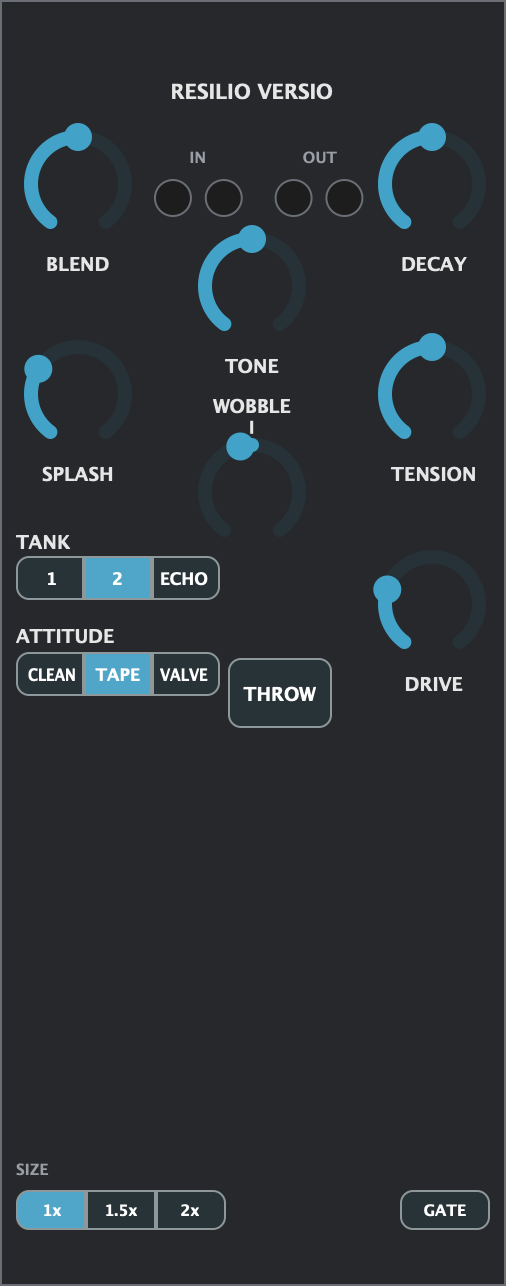
The plugin (AU and VST3, macOS) has the same panel, sound and LEDs. A few things work differently to suit a DAW:
- THROW is the panel button (hold it with the mouse). It reads TAP in TANK ECHO.
- GATE (the switch next to it) stands in for the gate jack, and on means gate high. In your DAW’s parameter list it’s called THROW, so you can automate throws.
- MIDI notes into the plugin act as the gate. A held note is gate high, timed to the sample, so a MIDI clip can sequence throws in TANK 1–2.
- In TANK ECHO the DAW’s tempo wins, and TENSION’s readout shows the note value.
- SIZE (1x, 1.5x, 2x) scales the panel.
- Use it on a return track with BLEND fully right, or as an insert with BLEND to taste.