Introduction
Resilio: Latin, “I leap back, rebound”.
I wanted a spring reverb I could play the way dub engineers played theirs.
Throw a snare into it, ride the filter like King Tubby, let the tail hang under the groove, or push it until it howls. There’s a worn tape echo in front of it too. It’s free firmware for the Versio, and the same sound runs as an AU/VST3 plugin on a Mac.
The sound
Tubby throw and sweep
A one-drop in A minor. The rimshot on bars 2, 4 and 6 is thrown into the springs, then the last two bars go in whole while TONE rides up to the “Big Knob” and back down the tail.
Transcript: A reggae one-drop at 76 bpm. Swung hi-hats with open-hat lifts, kick and rimshot together on beat three, soft cross-stick ghosts, and a roots bassline that leaves gaps. On bars two, four and six the rimshot alone splashes into the springs and rings on. Then the whole band goes into the springs for the last two bars, and the reverb turns thin and bright like a telephone, holds there, and warms up again as the long tail fades.
Settings for Tubby throw and sweep
Settings for Tubby throw and sweep TANK 2 ATTITUDE TAPE BLEND 0.5, the slider's start DECAY 0.72 TONE 0.55 TENSION 0.35 SPLASH 0.55 DRIVE 0.22 WOBBLE 0.45 Drums: Virtuosity Drums by Versilian Studios and Karoryfer (CC0). Bass: Baby Blue by Karoryfer (CC0). Played in code.
Organ bubble into echo
The reggae organ bubble and guitar chops into the tape echo, clocked to the tempo on dotted eighths. In the last bar the band stops and the echo answers.
Transcript: An organ plays the reggae bubble, a shuffling two-handed pattern of short chords, over A minor seven and D nine at 76 bpm. A clean guitar chops on beats two and four. Each chord comes back as dotted-eighth repeats that fall between the beats and thicken the shuffle. In the last bar the organ stops after two beats and the final guitar chops repeat on their own and fade.
Settings for Organ bubble into echo
Settings for Organ bubble into echo TANK ECHO ATTITUDE TAPE BLEND 0.45, the slider's start DECAY 0.55 TONE 0.5 TENSION 0.5 SPLASH 0.4 DRIVE 0.18 WOBBLE 0.44 CLOCK 76 bpm Organ: FreePats Drawbar Organ (CC0). Guitar: Emilyguitar by Karoryfer (CC0). Played in code.
Trombone dub
A trombone calls and the echo answers in the gaps. On the last phrase DECAY comes up so the repeats pile up, then a turn of TENSION bends the tape.
Transcript: A lone trombone plays three short phrases in A minor at 74 bpm, leaving a bar of space after each. The echo fills the space with a few dotted-eighth repeats. On the last phrase the repeats grow longer and louder and keep going after the horn stops. Near the end the repeats swoop up in pitch as the delay time shortens, then fade.
Settings for Trombone dub
Settings for Trombone dub TANK ECHO ATTITUDE TAPE BLEND 0.5, the slider's start DECAY 0.45 TONE 0.5 TENSION 0.5 SPLASH 0.4 DRIVE 0.2 WOBBLE 0.45 CLOCK 74 bpm Trombone: VSCO 2 CE by Versilian Studios (CC0). Played in code.
Chord stab into the bed
Dub techno in F minor. Short minor-ninth stabs feed a held spring bed that ducks under each kick, with WOBBLE far left for a seasick tape warble. DECAY comes down at the end to let it go.
Transcript: A four-on-the-floor kick at 120 bpm with a quiet offbeat hi-hat, and short, syncopated F minor ninth chord stabs on a bright FM keyboard. The springs hold every stab as a continuous wash that dips with each kick and swells between them. After the last stab the wash hangs on for two seconds, then fades away. The bed wavers in pitch the whole time, like a badly worn tape.
Settings for Chord stab into the bed
Settings for Chord stab into the bed TANK 2 ATTITUDE CLEAN BLEND 0.5, the slider's start DECAY 1 TONE 0.6 TENSION 0.5 SPLASH 0.4 DRIVE 0.2 WOBBLE 0.1 Clavisynth by Versilian Studios (CC0). Kick and hat: Virtuosity Drums by Versilian Studios and Karoryfer (CC0). Played in code.
Echo chord
One chord every two bars into the tape echo on dotted eighths. TONE rides from warm and dark all the way up to a thin telephone ring, then back down, the classic dub techno filter move.
Transcript: A single F minor ninth stab every two bars at 120 bpm, sometimes with a softer second stab pushed just after it. Each stab repeats as a trail of dotted-eighth echoes that fall across the beat. Over the clip the repeats slowly brighten, then darken again.
Settings for Echo chord
Settings for Echo chord TANK ECHO ATTITUDE TAPE BLEND 0.5, the slider's start DECAY 0.6 TONE 0.35 TENSION 0.5 SPLASH 0.4 DRIVE 0.2 WOBBLE 0.44 CLOCK 120 bpm Clavisynth by Versilian Studios (CC0). Played in code.
Vibes in the springs
Slow minor-ninth chords on soft vibraphone, with a warm tail and a little tape drift.
Transcript: A vibraphone plays gently rolled chords in D minor, one every few seconds, with a few single notes in between. The springs add a soft, wide bloom behind each chord that drifts very slightly in pitch, and the last chord rings out with a high note on top.
Settings for Vibes in the springs
Settings for Vibes in the springs TANK 2 ATTITUDE CLEAN BLEND 0.45, the slider's start DECAY 0.72 TONE 0.45 TENSION 0.5 SPLASH 0.2 DRIVE 0.12 WOBBLE 0.43 VCSL vibraphone by Versilian Studios (CC0). Played in code.
Zither drips
Sparse plucks on a Vietnamese zither, each one dripping into a single spring. Bent notes and a quick run up the strings.
Transcript: A Dan Tranh, a plucked Vietnamese zither, plays a slow pentatonic figure with long silences. Every pluck sets off the springy drip of a single reverb tank. Midway there is a fast run up the strings, and two notes are bent upwards after they are plucked.
Settings for Zither drips
Settings for Zither drips TANK 1 ATTITUDE TAPE BLEND 0.5, the slider's start DECAY 0.6 TENSION 0.6 SPLASH 0.45 TONE 0.5 DRIVE 0.18 WOBBLE 0.44 Dan Tranh by Versilian Studios (CC0). Played in code.
Percussion in the springs
Bongos and an 808 cowbell. A few cowbell hits are thrown into the spring and splash, while everything else stays dry.
Transcript: Bongos play a busy sixteenth-note pattern of open and muted hits at 118 bpm, with an 808 cowbell on the offbeats and a soft kick from the second bar. Now and then a single cowbell hit bursts into a short, metallic splash of spring reverb while the rest of the groove stays dry.
Settings for Percussion in the springs
Settings for Percussion in the springs TANK 1 ATTITUDE CLEAN BLEND 0.5, the slider's start DECAY 0.55 TONE 0.55 TENSION 0.5 SPLASH 0.5 DRIVE 0.15 WOBBLE 0.44 Bongos by Versilian Studios (CC0). TR-808 cowbell from Michael Fischer's 808 set via TidalCycles (CC0). Kick: Virtuosity Drums by Versilian Studios and Karoryfer (CC0). Played in code.
Guitar warble
A clean guitar letting slow E minor chords ring, with WOBBLE right of noon for a steady tape warble and TENSION loose for a big, slow boing.
Transcript: A clean electric guitar picks slow, ringing arpeggios over E minor nine, C major seven, A minor nine and B seven sus at 72 bpm, ending on a soft strum. The spring tail wavers evenly in pitch, a gentle vibrato, and each note blooms with a deep, slow boing.
Settings for Guitar warble
Settings for Guitar warble TANK 2 ATTITUDE TAPE BLEND 0.5, the slider's start DECAY 0.62 TONE 0.45 TENSION 0.28 SPLASH 0.35 DRIVE 0.15 WOBBLE 0.68 Guitar: Emilyguitar by Karoryfer (CC0). Played in code.
The rough end
VALVE with DRIVE up. One call of a sound-system siren, a beep then two notes flipping, tips the tank into its howl. DECAY eases down from 9 seconds and the howl settles into a long tail.
Transcript: A sound-system siren, a single beep followed by a high and a low note flipping quickly back and forth, once. The springs catch it and keep going on their own as a rough, moving roar. From nine seconds the roar slowly loosens over several seconds, then rings out as a long tail.
Settings for The rough end
Settings for The rough end TANK 2 ATTITUDE VALVE BLEND 0.4, the slider's start DECAY 0.95 TONE 0.5 TENSION 0.35 SPLASH 0.4 DRIVE 0.65 WOBBLE 0.42 Siren synthesised in code.
King Tubby’s “Big Knob”
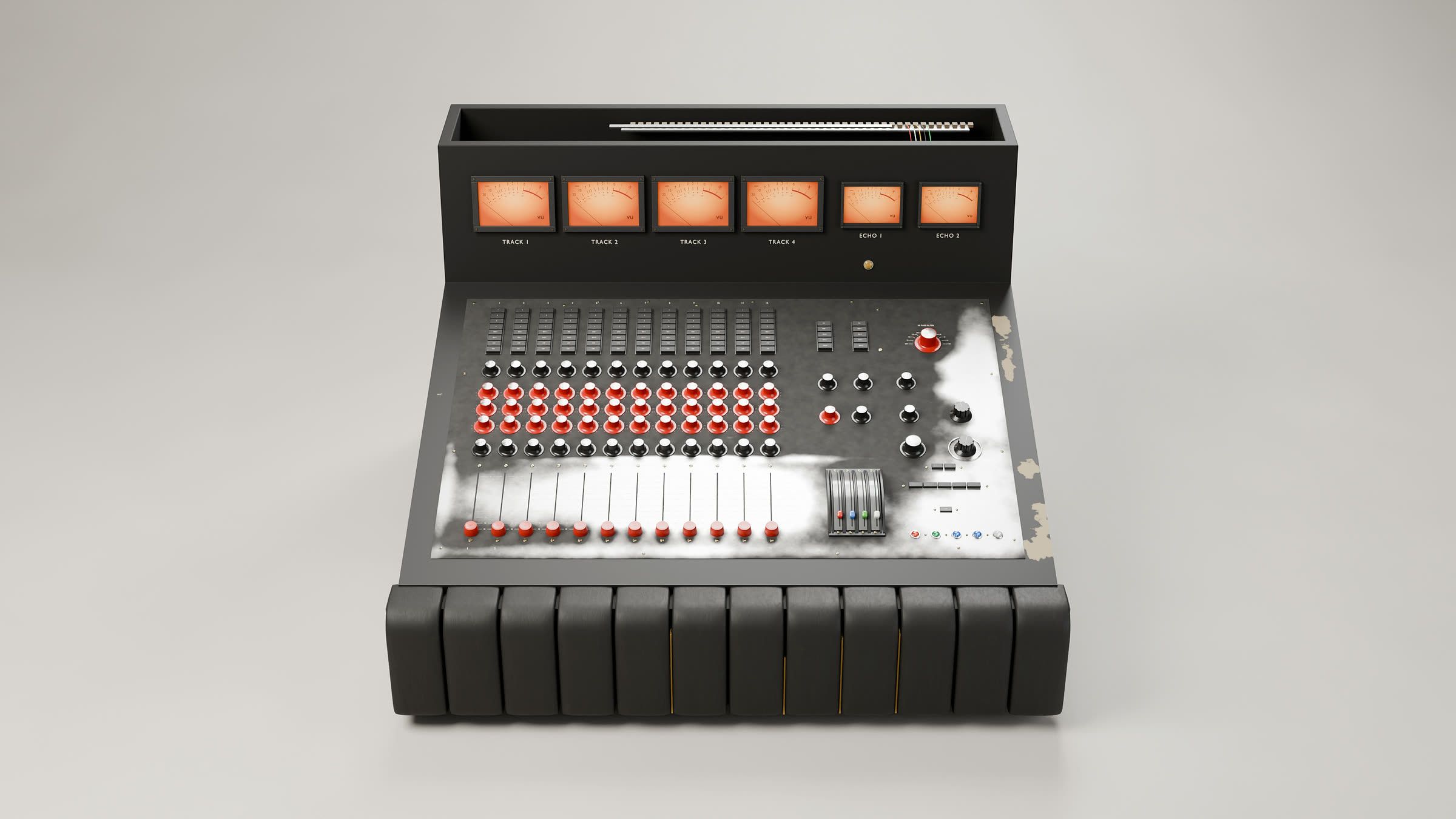
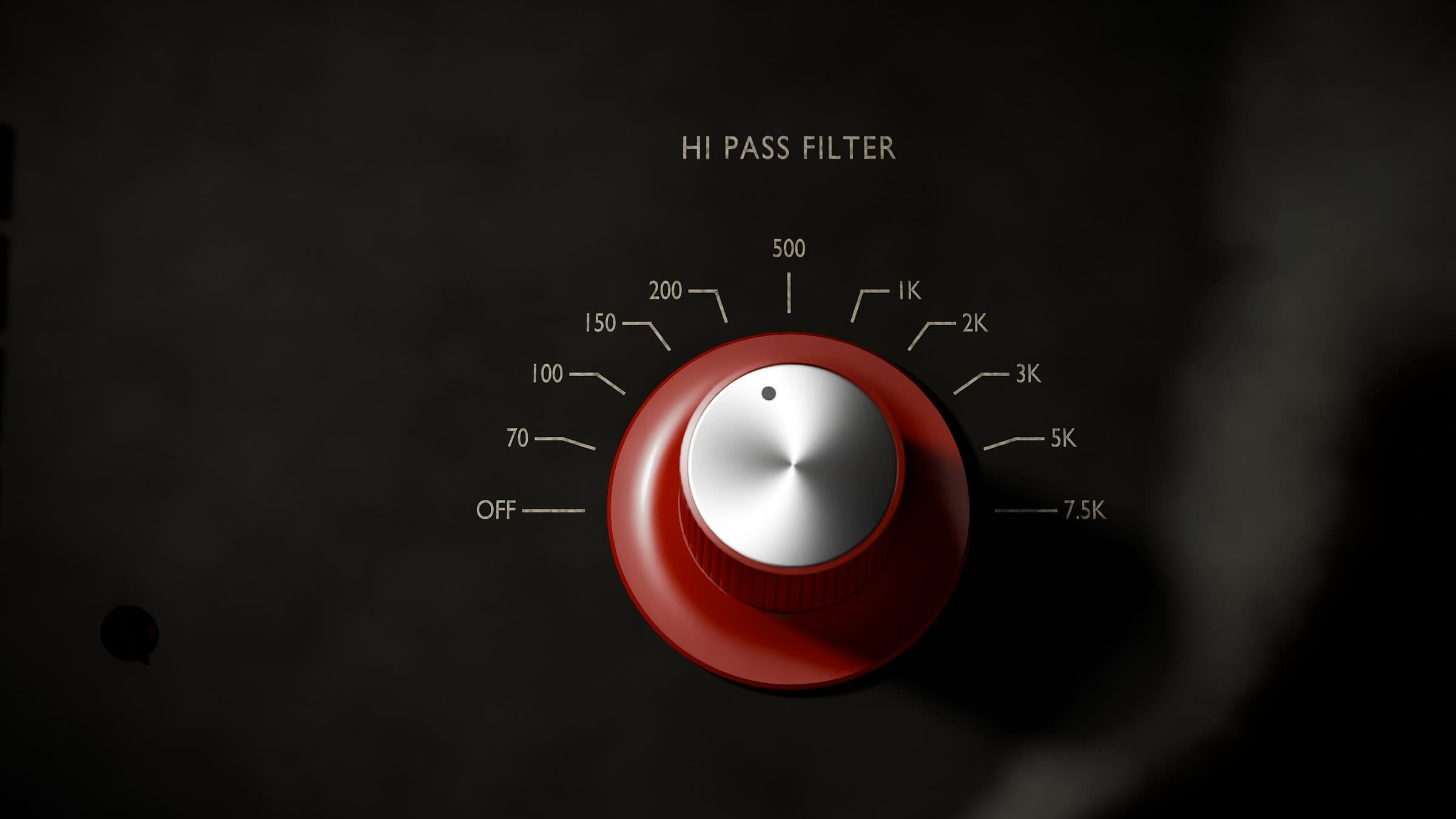
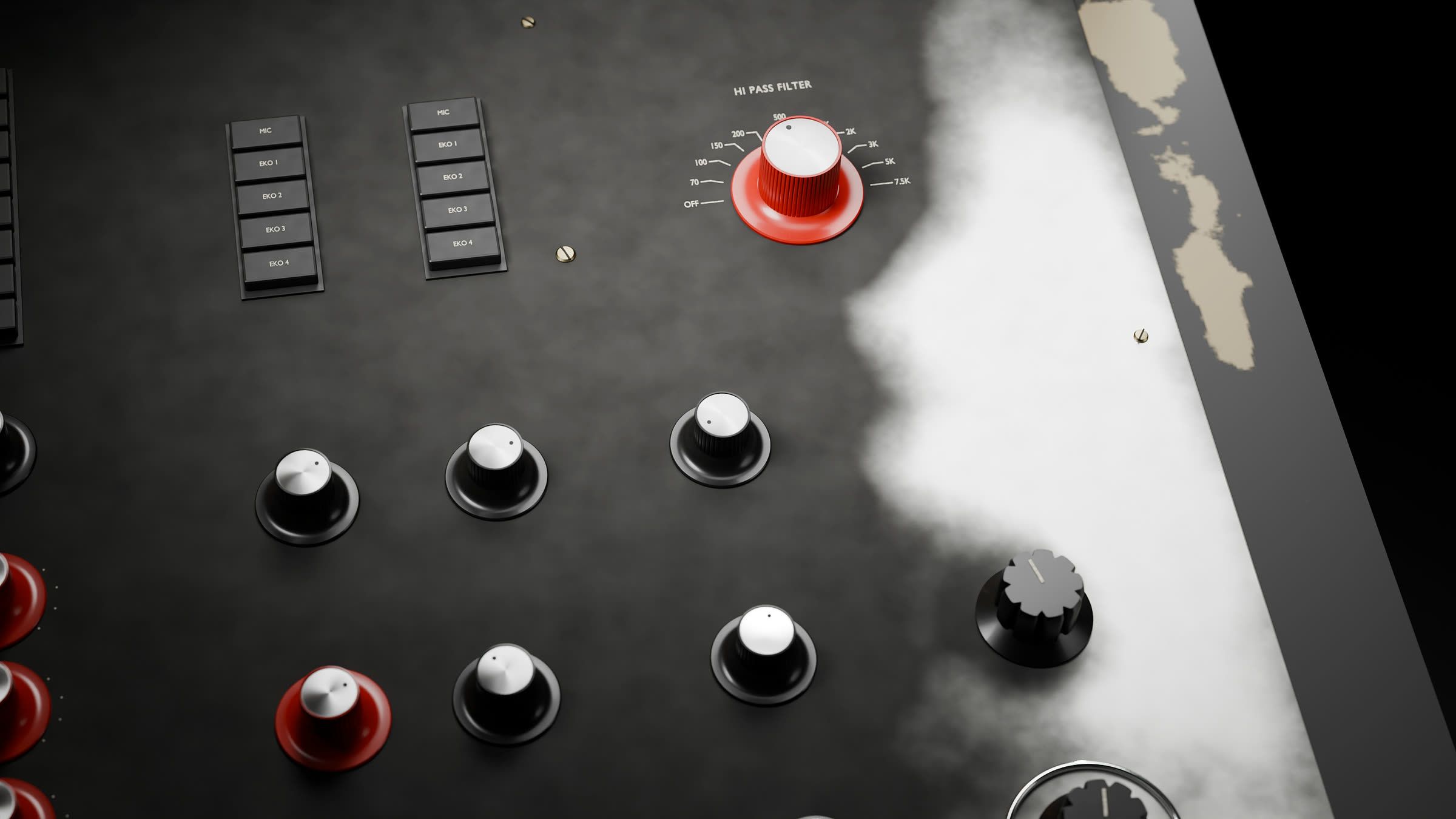
In 1972 King Tubby bought an older MCI mixing desk from Dynamic Sounds, Byron Lee’s studio in Kingston. Fitted to it was an Altec 9069B, a passive high-pass filter made of two capacitors and a coil, built for cutting rumble in broadcast and film work. On the desk it was a large red knob marked HI PASS FILTER. Tubby called it the “Big Knob”.
It cuts the lows at 18 dB per octave, in fixed steps from 70 Hz up to 7.5 kHz. Tubby switched it on the reverb and echo sends and returns as the track played. Each click thins the sound further, until a snare turns into a telephone ring and then a squeak, and you can hear each step click in.
I modelled the right half of Resilio’s TONE knob on it. It has the same steep slope on the spring return, up to 800 Hz. I made it sweep smoothly rather than click through steps, so you can ride it by hand or with CV.
The panel
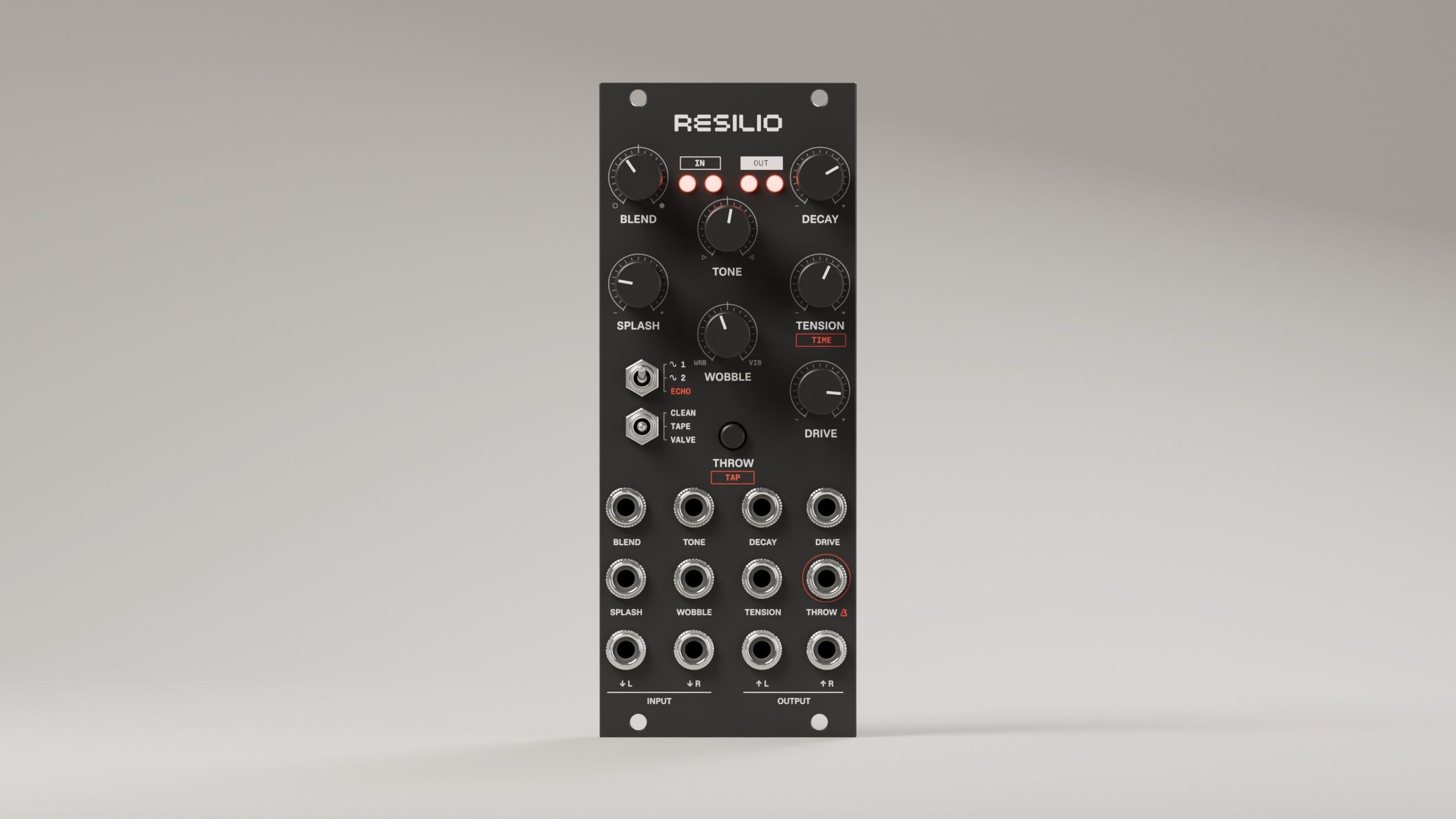
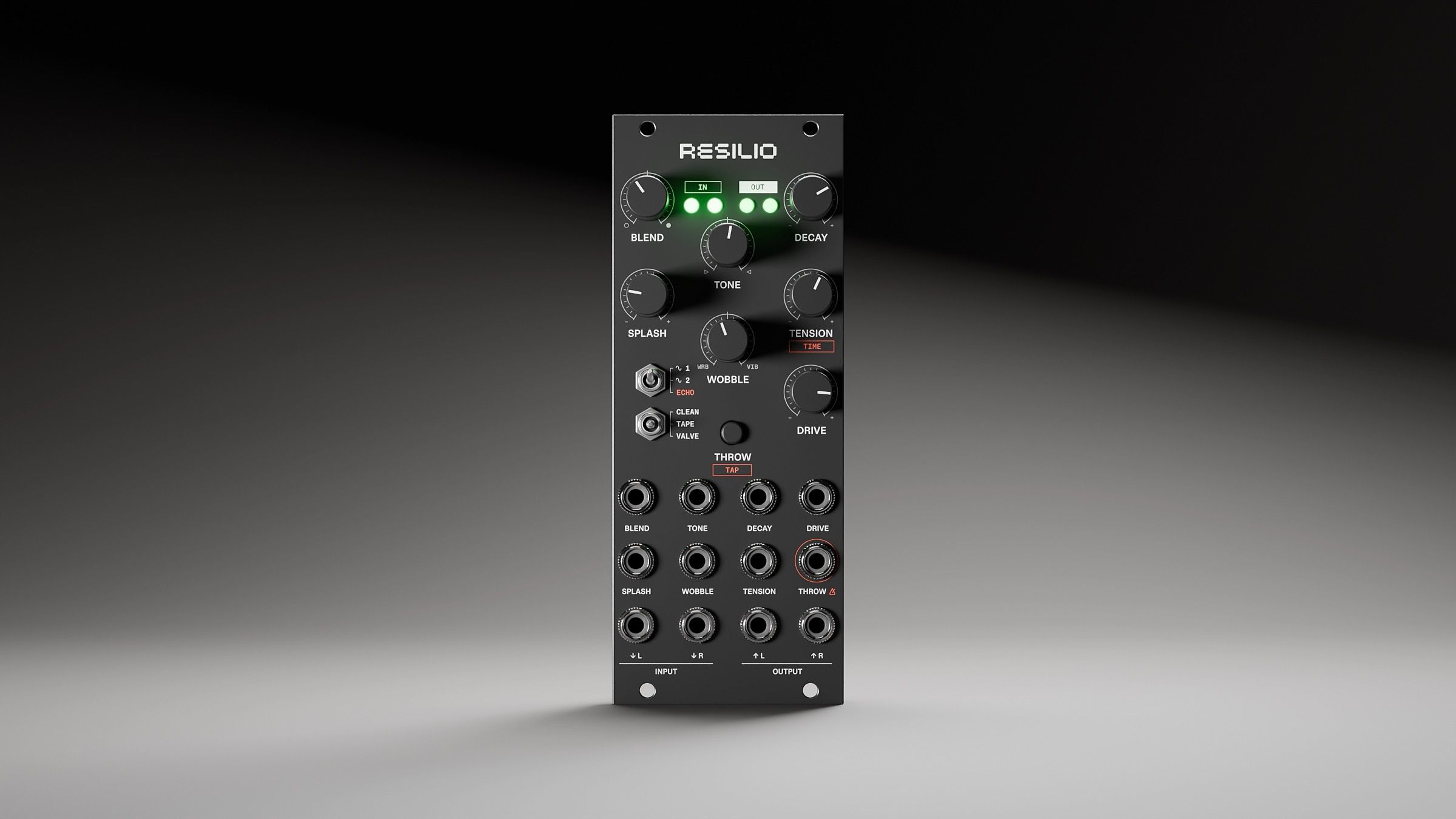
- BLENDDry ↔ wet. Fully right is 100 % wet, for a send and return.
- DECAYHow long the tail rings, from a quick slap to a long wash. At the top it holds in CLEAN and TAPE, and howls in VALVE.
- TONEWarm and dark on the left, neutral at noon, King Tubby’s “Big Knob” low cut on the right.
- SPLASHHow hard your hits hit the springs.
- TENSIONWhich tank is fitted. Tight and quick to the right, loose with a big boing to the left.
- WOBBLEPitch movement. Tape drift left of noon, a steady warble right of it.
- DRIVEHow hard you hit the tank, up to +24 dB. Colour and grit build as you turn it up.
- TANKOne spring, two springs, or a tape echo into the springs.
- ATTITUDEThe saturation inside the tank. TAPE and VALVE also add 12- or 10-bit µ-law grit to the reverb.
- THROW / TAPThrows in TANK 1 and 2, and taps the echo’s tempo in TANK ECHO.
- GateThrows in TANK 1 and 2, and clocks the echo in TANK ECHO.
- 4 LEDs Meter the input and output
- 7 knobs BLEND, DECAY, TONE, SPLASH, TENSION, WOBBLE, DRIVE
- 2 switches TANK (1 · 2 · ECHO) and ATTITUDE (CLEAN · TAPE · VALVE)
- 1 button THROW / TAP
- 7 CV inputs One per knob, 0–5 V, added to the knob’s position
- 1 gate input Throws, or clocks the echo
Built around dub performance moves
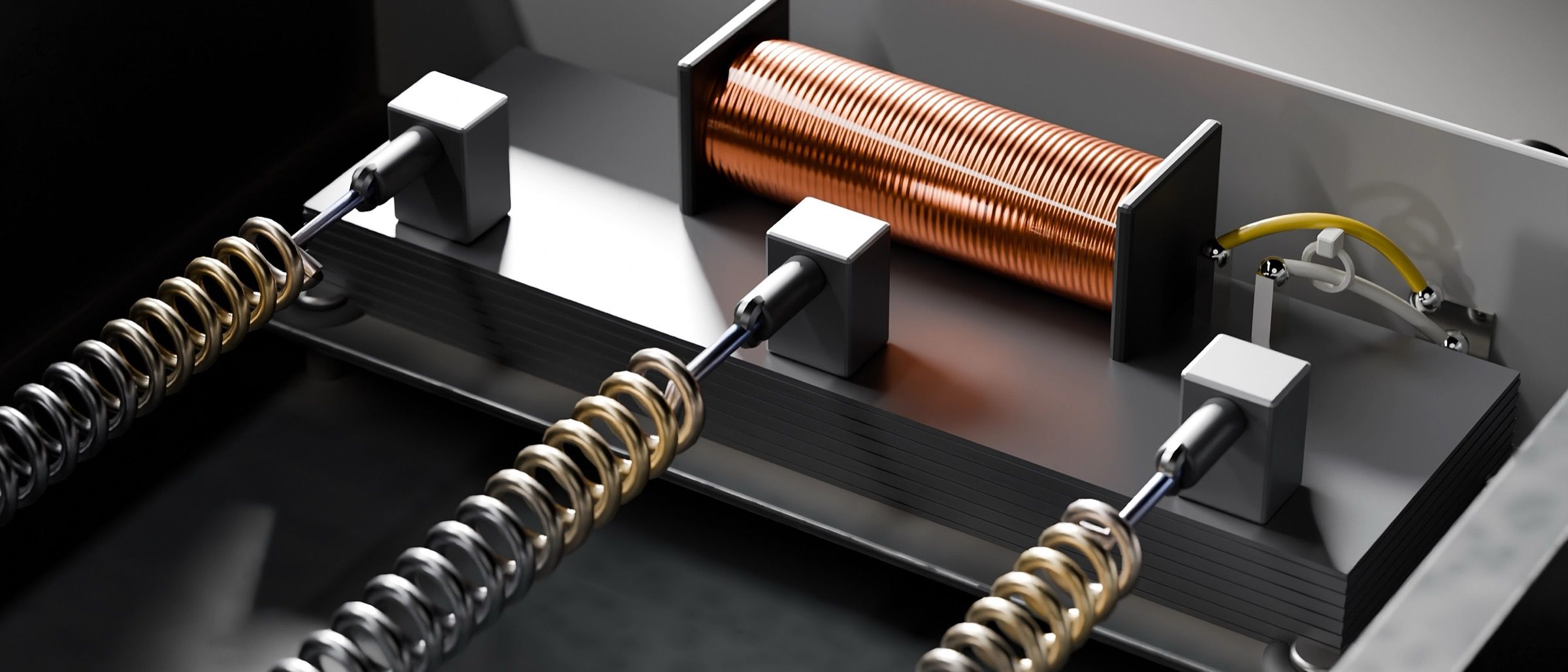
2 springs
One spring in TANK 1, sparse and the splashiest. Two in TANK 2, the classic tank.
Tape echo
TANK ECHO puts a worn tape echo in front of the springs. Clock it from your sequencer or tap it in.
3 attitudes
Three kinds of saturation inside the tank, with µ-law grit on the reverb in TAPE and VALVE. Your dry signal stays clean.
The throw
Open the springs for one snare, close them again and let the tail ring on. The button and the gate input both do it.
WOBBLE
Tape drift left of noon, a steady warble right of it.
SPLASH
Makes your hits hit the springs harder. Ghost notes stay quiet.
The “Big Knob”
The right half of TONE is King Tubby’s steep low cut, up to 800 Hz. Sweep it by hand or with CV.
The howl
In VALVE, the top of DECAY lets the tank feed back into a howl you can ride. Pull DECAY back and it falls into a normal tail.
Colour: saturation and grit
µ-law grit
TAPE and VALVE send the reverb through a 24 kHz µ-law converter, the grain you hear on early digital delays and samplers. Its steps are coarse on loud hits and fine on quiet tails, so a fading tail turns to grain before it goes silent.
TAPE: 12-bit
A fine grain on top of the tape saturation. This is the core dub colour.
VALVE: 10-bit
Coarse and clearly gritty, on top of the valve’s hard, lopsided saturation.
Only on the reverb
Your dry signal stays as it is, and CLEAN leaves the reverb alone too. The grit comes before TONE, so turning TONE right thins the grit along with the tail.
24 kHz
Half the usual sample rate. The top octave, above about 11 kHz, is cut cleanly, so nothing aliases.
Two ways to play
On the module
Firmware for the Noise Engineering Versio
Resilio replaces the module’s firmware completely, and it’s just as easy to go back. You install it with Noise Engineering’s own Firmware Swap web app, and the same app puts any Noise Engineering firmware back on. Resilio doesn’t change anything else on the module.
In your DAW
AU/VST3 plugin for macOS
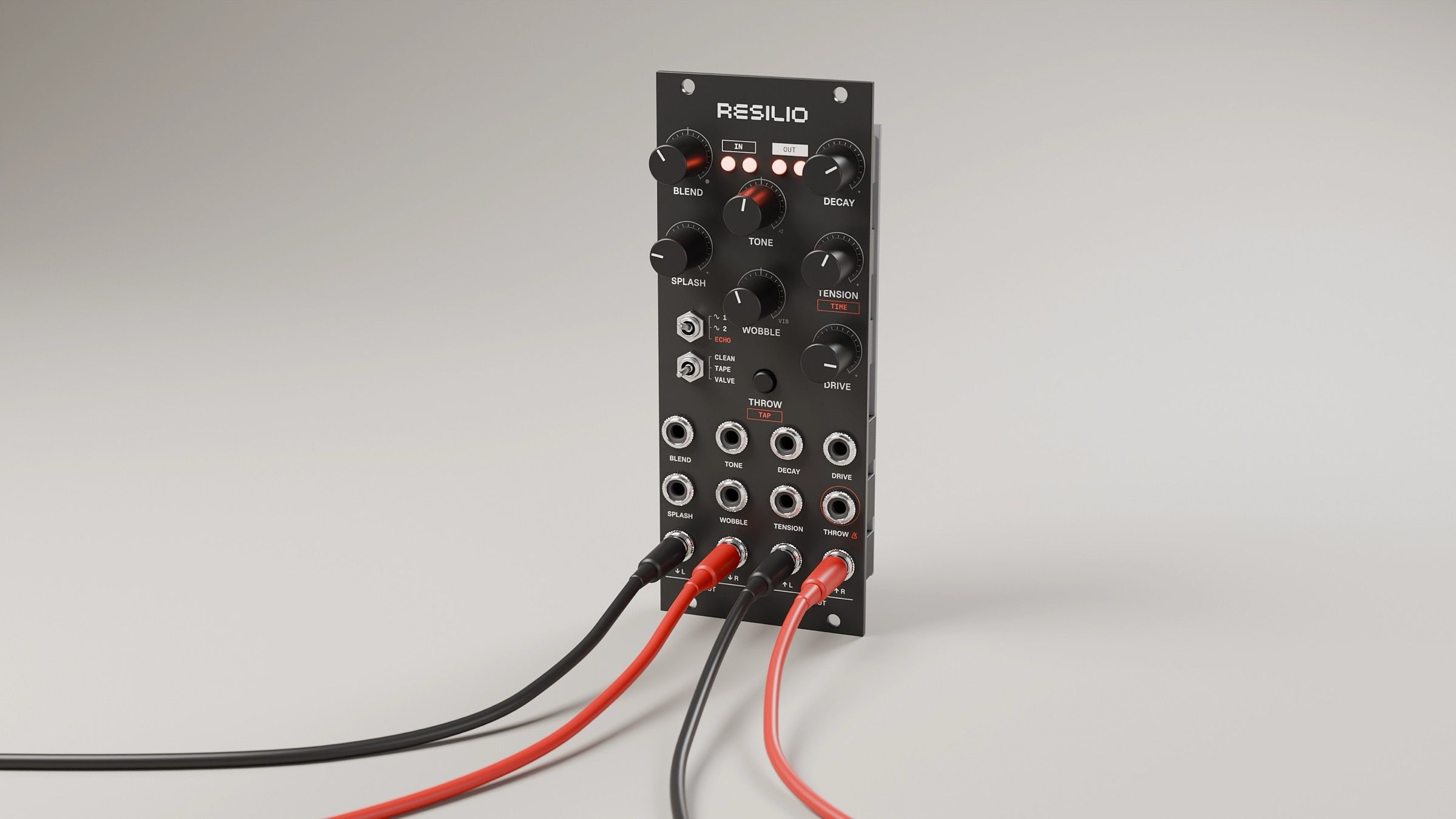
The same sound engine runs as an Audio Unit and VST3 plugin for macOS, laid out like the module’s panel. You can sketch a patch in your DAW and throw from a MIDI clip, and in echo mode it follows your tempo. You don’t need a Versio to use it.
Help shape it
Play it
On the module or in your DAW, with your own sounds.
Tell me
Open a GitHub issue with an idea for the sound, or a bug.
Hear it change
I try ideas by ear, and credit the ones that ship.
Download
This is the first public release. The firmware works and I play it on real hardware, but the sound may still change between versions. I’d like to hear what you think on GitHub Issues.
I’m a designer, not a DSP engineer. I made every sound decision by ear, and Claude (Anthropic’s AI) wrote the DSP, the firmware and the tools. Credits
Resilio Versio is an independent project. It is not affiliated with or endorsed by Noise Engineering.
Latest release
v2026.10.07-0671d22What’s new
For your Versio
Firmware for Versio (.bin)128 KBYou’ll need
- A Noise Engineering Versio module.
- A computer with Chrome and a micro-USB data cable.
- Noise Engineering’s Firmware Swap web app. It installs Resilio and puts their firmware back whenever you like.
For your DAW
Plugin for macOS (AU/VST3)7.8 MBYou’ll need
- macOS 12 or newer, Apple Silicon or Intel.
- A DAW that loads AU or VST3. No Windows or Linux build.
- It isn’t notarised by Apple, so it takes one Terminal step to open.